Back to search results
BACO FOOD PRODUCTS FACTORY (HO328)
121-129 CRAIG STREET SPOTSWOOD, HOBSONS BAY CITY
BACO FOOD PRODUCTS FACTORY (HO328)
121-129 CRAIG STREET SPOTSWOOD, HOBSONS BAY CITY
All information on this page is maintained by Hobsons Bay City.
Click below for their website and contact details.

Hobsons Bay City

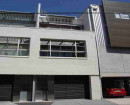
Craig Street facade – west end


On this page:
Statement of Significance
What is significant?
The former Baco Food Products building at 121-129 Craig Street, Spotswood, constructed in 1948 for Baco Food Products, and later the site where Spring Valley Juices were first produced, is locally significant.
Significant elements include the following original or early elements:
Significant elements include the following original or early elements:
- Hipped roof form,
- Rendered and concrete block elevations,
- Ribbed panels to Craig Street facade,
- Original openings with metal-framed windows with textured safety glass,
- Recessed entry with metal security gates and granolithic tiled flooring,
- Vehicle entrances to McNeilage and Ramsay street elevations with metal roller door.
Elements that do not contribute to the significance of the place include the following non-original elements:
- Recent upper-level addition,
- Two awnings to west end of Craig Street facade,
- Infilled door to east end of Craig Street elevation.
How is it significant?
The former Baco Food Products is historically and aesthetically significant to the City of Hobsons Bay.
Why is it significant?
The former Baco Food Products is historically significant as it illustrates the desirability of the Spotswood area for various types of industry in the post-WWII period.
Spotswood was established as a major centre for industry during the late 19th century, with new operations and existing concerns relocating from other parts of the city seeking vacant sites with water access and proximity to central Melbourne. Through the Interwar period, the enlargement of the Victorian Railway’s facilities in the area and industrial sites like the immense Australian aConsolidated Industries complex on Booker Street, further solidified this circumstance.
The Post-WWII period saw Spotswood become entrenched as key centre of industry and manufacturing in Melbourne, anchored by the established concerns including the Australian Glass Manufacturing site and buoyed by the large-scale development of petrochemical and refinery operations oil industry which developed south of Craig Street during the late interwar and post-WWII periods. The construction of the Baco Food Products building, a relatively small-scale manufacturing site for baking confectionary which later pivoted to bottling fruit juice, demonstrates this growth into a diverse industry nexus by this period.
(Criterion A)
The Post-WWII period saw Spotswood become entrenched as key centre of industry and manufacturing in Melbourne, anchored by the established concerns including the Australian Glass Manufacturing site and buoyed by the large-scale development of petrochemical and refinery operations oil industry which developed south of Craig Street during the late interwar and post-WWII periods. The construction of the Baco Food Products building, a relatively small-scale manufacturing site for baking confectionary which later pivoted to bottling fruit juice, demonstrates this growth into a diverse industry nexus by this period.
The former Baco Food Products is aesthetically significant as a well-resolved and largely intact example of an industrial building designed in the Functionalist style during the early post-WWII period. Typical of that style, the building has a largely unadorned expression to the exterior which reflects the internal function of the manufacturing programme.
The restrained expression of the Craig Street facade is typical of the Functional style with a pronounced horizontal emphasis provided by an extensive use of metal-framed windows in a distinct band and which is enhanced by the distinctive ribbed panels of the main rendered administrative section. The latter section is also distinguished the contrasting verticality of the off-centre entry bay that extends above the main level of the parapet and features a recessed entrance with a metal security gate and granolithic tiled entrance.
(Criterion E)
The restrained expression of the Craig Street facade is typical of the Functional style with a pronounced horizontal emphasis provided by an extensive use of metal-framed windows in a distinct band and which is enhanced by the distinctive ribbed panels of the main rendered administrative section. The latter section is also distinguished the contrasting verticality of the off-centre entry bay that extends above the main level of the parapet and features a recessed entrance with a metal security gate and granolithic tiled entrance.
Show more
Show less
-
-
-
-
-
SWAN HILL WATER TOWER
 Victorian Heritage Register H2452
 -
RULES OF THE MELBOURNE FOOTBALL CLUB
Victorian Heritage Register H2428
-
MOUNT LITTLE DICK FIRE TOWER
Victorian Heritage Register H2461
-
Anunaka Mansion
 Casey City
 -
Axedale Hall
 Greater Bendigo City
 -
BEAUFORT HOUSE
 Merri-bek City
-
-