KALKALLO POLICE PADDOCK SITE
1310 HUME HIGHWAY KALKALLO, HUME CITY
-
Add to tour
You must log in to do that.
-
Share
-
Shortlist place
You must log in to do that.
- Download report
Statement of Significance
Data has been updated as a result of the Outer Western Metro Project, Context, March 2010.
What is significant?
How is it significant?
Why is it significant?
-
-
KALKALLO POLICE PADDOCK SITE - History
The Donnybrook Village Reserve was set aside in the original 1838 survey and its street pattern was determined by about 1850. The settlement (originally known as 'Rocky Water Holes') was a hive of activity by 1849, with the Argus of 12 December that year recording 'a fine store . two first rate inns, a post office, a watch-house etc.' and that passing traffic was 'very great. no less than 98 drays loaded with wool touched at this place last week'.
Between 1840 and 1860 the settlement was an important overnight stop for bullock-drivers and travellers to the north-east. The village was surveyed in 1852 and re-named Donnybrook when the post office was transferred here from Kinlochewe in 1853.
The settlement especially flourished during the 1850s because of travellers to the gold fields, at which time it had a gaol and courthouse, a church, a school, a tannery and a flour mill. A cemetery was established in the locality around 1860, and by the mid 1870s most of the land in the area was well established as agricultural and pastoral freehold and village settlements had sprung up both at the railway line at the current Donnybrook and on the main north-south roads. To reflect this separation, the latter was renamed Kalkallo in 1874 by government proclamation.
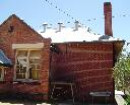
A police station was located on this site from at least 1853 when a halting place for the gold escort was established here. It would appear that the site continued as a police station until the beginning of the 20th century, but a township plan shows the northern portion to have be in the control of a state school from 1913.
The site is now in private ownership.
(Partly derived from Maloney & Johnson 1998)
SiteCard data copied on 28/10/2025:The activity area, 1310-1320 Hume Freeway, is located within Section 31 of the surveyed Kalkallo township, bounded by Yaldwin, Mitchell, Mason and Hawkey (now Hume Freeway) Streets. An 1853 plan of the town shows Sections 31 and 32 as being "Reserved for Police Purposes’ with two police buildings partially obscured by the “O” and “L” in police. The adjacent land was used to stable and depasture police horses. The first known building on the site was a lock-up constructed of fieldstones and mud, the erection of which began in 1849 and was completed in 1850 (The Argus 20 Dec 1849:2; 31 Jan 1850:2). A foot constable and mounted trooper were stationed at Kalkallo in 1853, and from March 1854, the official gold escort from the Ovens goldfield stopped at the Kalkallo Police Station en route to Melbourne. The escort consisted of eight or nine mounted troopers along with at least twelve horses and required considerable accommodation (Payne 1980: 19). In 1858, a bluestone lock-up with three cells had been constructed, to replace the original mud and stone structure, as well as a bluestone courthouse building (Victoria Government Gazette 23 July 1858: 1398; ibid. 3 August 1858: 1459; Payne 1980: 20). By 1860, the Kalkallo police barracks consisted of a senior constable’s quarters, officers’ quarters, quarters for the gold escort and a stable building with fifteen stalls. The Senior Constable’s quarters were made up of one part of slabs patched with shingles, the other half being the old lock-up built of rough boulder stones plastered together with mud. The Officer’s quarters were at least partially made of wood. The escort quarters were wood and lined with canvas which was formerly on the roof of the long stable. The stables were made of various materials; one slab, 3 stalls; one weatherboard and framed, 5 stalls; one weatherboard and roofed iron, 7 stalls (in Payne 1980: 19). In 1869, a new bluestone police station was constructed (Victoria Government Gazette 17 December 1869: 1996). The new building consisted of four rooms, with one doubling as the constable’s office and bedroom (Payne 1980: 2021). By 1887, only four wooden horse stalls remained of the stables, as well as a wooden forage shed (Payne 1980: 21). The police station/residence, courthouse and lockup were all made of stone. The police station was broken up in 1890 (Victoria Police Gazette 7 May 1890: 148). In 1913 the former police reserve was subdivided, Allotments 1 and 3 were sold to farmers and allotment 2 was sold to the Education Department. Allotment 2 and the bluestone station were used as housing for the Kalkallo schoolmaster's residence. In 1956 the building was demolished (The Argus 13 July 1956: 14; Payne 1980: 15-17). Allotment 1 was further subdivided, and the western section, within the activity area, has been used as a car park by the Kalkallo Hotel across the road. Allotment 3 has been used for farming and has had a series of large sheds and a residence within its perimeters.KALKALLO POLICE PADDOCK SITE - Interpretation of Site
A large concrete foundation of early 20th century appearance is located at the western end of the site. This incorporates a surface drain and is approached from the east by a concrete path which then forms a t-junction, extending to north and south. The foundation is accompanied by the metal stand of a water tank and what appears to be the top of a subterranean vaulted concrete cistern. No building footings are apparent, and all of these features point to this being the site of a wooden structure, perhaps relating to the site's post 1913 state school ownership.
It is possible that this foundation overlies evidence of the earlier police station.
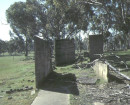
To the east of the concrete foundation, a slight depressionmay bethe site of a dam in what would most likely have been the police paddocks. Further to the east, in a clump of cypress and pine trees at the eastern end of the site, is a subrectangular area of slightly raised ground, featuring a row of bluestones which could be wall footings and an area of bluestone paving at its eastern edge. This may represent the site of the 19th century police station, or perhaps a related outhouse or stable building.
A large 20th century timber and iron shed occupies the north eastern corner of the site, together with a concrete water tank. SiteCard data copied on 28/10/2025: The site consists of building archaeology and associated features and deposits of a 1850s police compound. The building archaeology occurs as in situ bluestone footings representing earlier and later phases of occupation. The building footings occur on two separate allotments, and there is a strong possibility that footings relating to an additional building are present beneath a third allotment, which includes the carpark opposite the Kalkallo Hotel. The artefacts so far occur in low densities but include a stong mid-19th century element in the form of ceramics, glass and pipe fragments. Early-mid 20th century uses of the site had little impact on either the extant or ruinous buildings. A late 20th century use of the site as a poultry farm also appears to have had minimal impact on the archaeology. The demolition of extant buildings in the mid-20th century, although done with machinery, has left the subfloor and footings-related masonry intact.KALKALLO POLICE PADDOCK SITE - Archaeological Significance
The site appears to be relatively undisturbed and it may therefore contain subsurface archaeological deposits of local historical significance.
KALKALLO POLICE PADDOCK SITE - Historical Significance
The site is historically important with regard to the development of the Donnybrook (Kalkallo) settlement during the middle of the 19th century, and in particular with its role in servicing the route north to the gold fields.
It is of significance with regards to the evident development of a police station and a school at the site, and its subsequent removal, illustrating the continued varying fortunes of the settlement into the 20th century.Heritage Inventory Description
KALKALLO POLICE PADDOCK SITE - Heritage Inventory Description
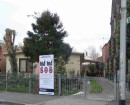
Bluestone footings of a structure at the eastern end of the site, to the south of modern agricultural sheds. At the west end of the site, on the opposite side of slight depression, is a concrete foundation with an underground concrete cistern and metal water tank holder.
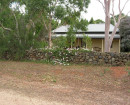
SiteCard data copied on 28/10/2025: 1310 Hume Freeway: Currently within the site boundary is a 20th-century shed structure located towards the northeastern corner of the property with two adjoining concrete water tanks. A concrete slab associated with a 20th-century house (now demolished) is located towards the western extent of the property. A series of Cyprus trees line the southwestern boundary. A grassy mound (unnatural) is visible in the northeastern corner of the property boundary next to the shed structure. Bluestone/basalt is scattered across the surface of the property and concentrated around the bases of the aforementioned trees. The origin of this material is not currently known and could be remnant building fabric. 1314 Hume Freeway: Within the site boundary are a number of mature trees. The majority of this property is a grassed paddock following the demolition of a 1950s house. At the centre of the property are remnant footings of the 1860s police station and residence. 1320: This property consists of a gravelled car park.
-
-
-
-
-
THANES HOTEL SITE, KALKALLO
Victorian Heritage Inventory -
ST BARNABAS ANGLICAN CHURCH RUIN
Victorian Heritage Inventory -
WILLIAM WILSON'S STORE SITE
Victorian Heritage Inventory
-
-